Project case study · Technical project
AGV Docking System
A fuzzy logic controller for precise docking of autonomous guided vehicles. A Silesian University of Technology research project published in the journal Sensors (MDPI).
At a glance
- Category
- Technical project
- Period
- May 2024 – Oct 2025
- Role
- Co-author of the paper. Implemented the fuzzy controller and the vehicle control software in Python, the simulator and the test-rig measurements.
- Team
- 6 co-authors, Silesian University of Technology (Gliwice)
- Scope of work
- Research & measurement
- Robotics & control
- Technologies
- Python
- /scikit-fuzzy
- /NumPy
- /pandas
- /Matplotlib
- /Pygame
- /UDP
Results
- Mean X / Y position error
- 47 / 39 mm
- Dead reckoning: 134 / 124 mm
- Mean heading error
- 6°
- Dead reckoning: 39°
- Test runs per method
- 36
- 4 starting positions × 3 angles × 3 trials
Project scope
A research project at the Silesian University of Technology within the CoBotAGV project, funded by the Norway Grants 2014–2021. The scope covered the fuzzy controller design, vehicle control software, a simulator, the measurement rig and a comparison against odometry.
Implementation decisions
Instead of adding sensors or a vision system, the project treats docking precision as a software problem: the final stage of the manoeuvre is handled by a dedicated controller that uses the sensors the vehicle already has. Splitting the manoeuvre into three stages keeps each rule base small and easier to tune. In the version described in the paper, the controller is a Takagi-Sugeno system implemented as a gain-scheduling lookup table driven by heading error and distance error.
Project context
The figures on this page come from prototype tests documented in the project repository. The full methodology, controller model and results are described in the paper "Controlling AGV While Docking Based on the Fuzzy Rule Inference System" (Sensors 2025, 25(19), 6108).
01
Introduction
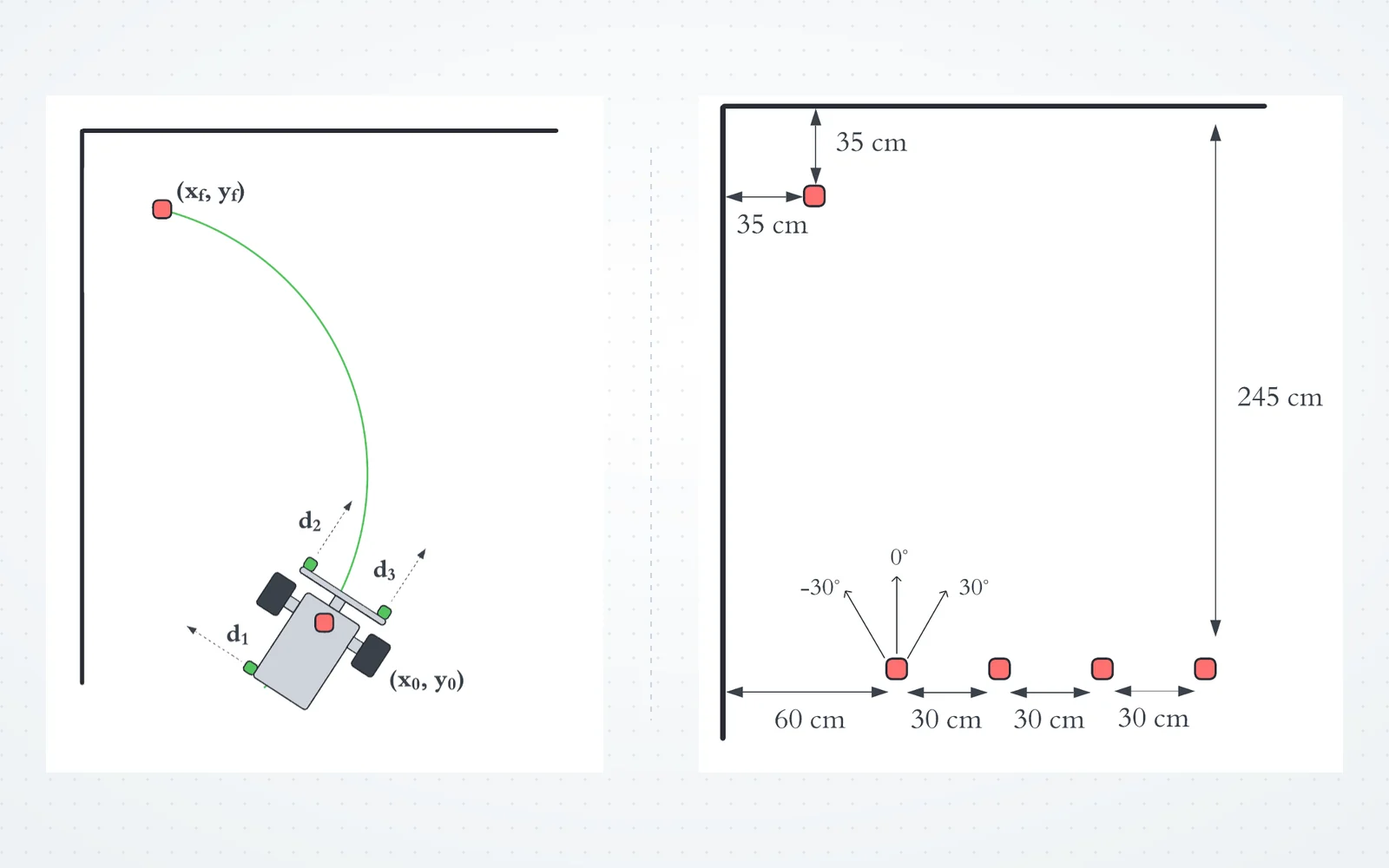
In an Industry 4.0 factory, an AGV has to stop at a workstation precisely enough for a collaborative robot arm with a limited working range to do its job. Odometry (dead reckoning) accumulates error exactly at that critical moment. The project solves this in software, with no new hardware: near the station the vehicle switches from global to local navigation, and a fuzzy logic controller guides it to the docking point using readings from three distance sensors.
02
What was built
Three-stage fuzzy controller
Separate controllers for approaching the wall, rotating towards the docking point and driving in parallel with path correction. Their outputs are left and right wheel speeds.
Global-to-local navigation switch
Near the workstation the vehicle switches from odometry to local navigation based on proximity sensor readings.
Real-time vehicle control
A Python program reads the sensors and sends drive commands over the network, correcting the path as it moves.
Simulator and test tooling
A Pygame motion simulator for checking rules, manual control with a PS4 gamepad, and scripts for measurement analysis and plots.
Comparison with odometry
The same measurement procedure for both methods: four starting positions, three initial angles and three trials per configuration.
03
Technologies used
Python
Control logic, vehicle communication and results analysis.
scikit-fuzzy
Controller prototype: linguistic variables, membership functions and rule bases for each stage.
NumPy, pandas and Matplotlib
Measurement processing and plots comparing both methods.
Pygame
Vehicle motion simulator and gamepad input for manual control.
AGV hardware
L298N motor driver and three single-beam distance sensors.